 Hyperbeat
 Card Payments: Cash Versus Credit Mode
Last updated ·
Hyperbeat Pay funds card purchases from an existing supported stablecoin balance in Cash mode or a loan against eligible collateral in Credit mode. Its Liquid Banking account is a self-custodial smart wallet on HyperEVM. Credit mode adds repayment obligations and liquidation risk. Card activation requires identity verification, and access depends on regional eligibility and the applicable cardholder agreement.
Article sections
Shared Settlement Permissions
- ManagementAccount
- The user owns this smart-contract wallet, which holds assets and connects to DeFi positions through service adapters. A service must be registered and explicitly approved by the user before it can interact with funds.
- Operator
- Hyperbeat’s backend handles card settlement under restricted permissions and a spending allowance that the user defines. The documented Operator role has no authority to upgrade contracts or change global registries.
- Approved Assets
- The token registry defines which assets the account can use for deposits, collateral, and settlement. Credit mode also depends on the collateral accepted by its approved lending service.
- Contract Upgrades
- ManagementAccount is upgradeable. Separate upgrade permissions and the factory’s implementation whitelist govern changes to its contract logic.
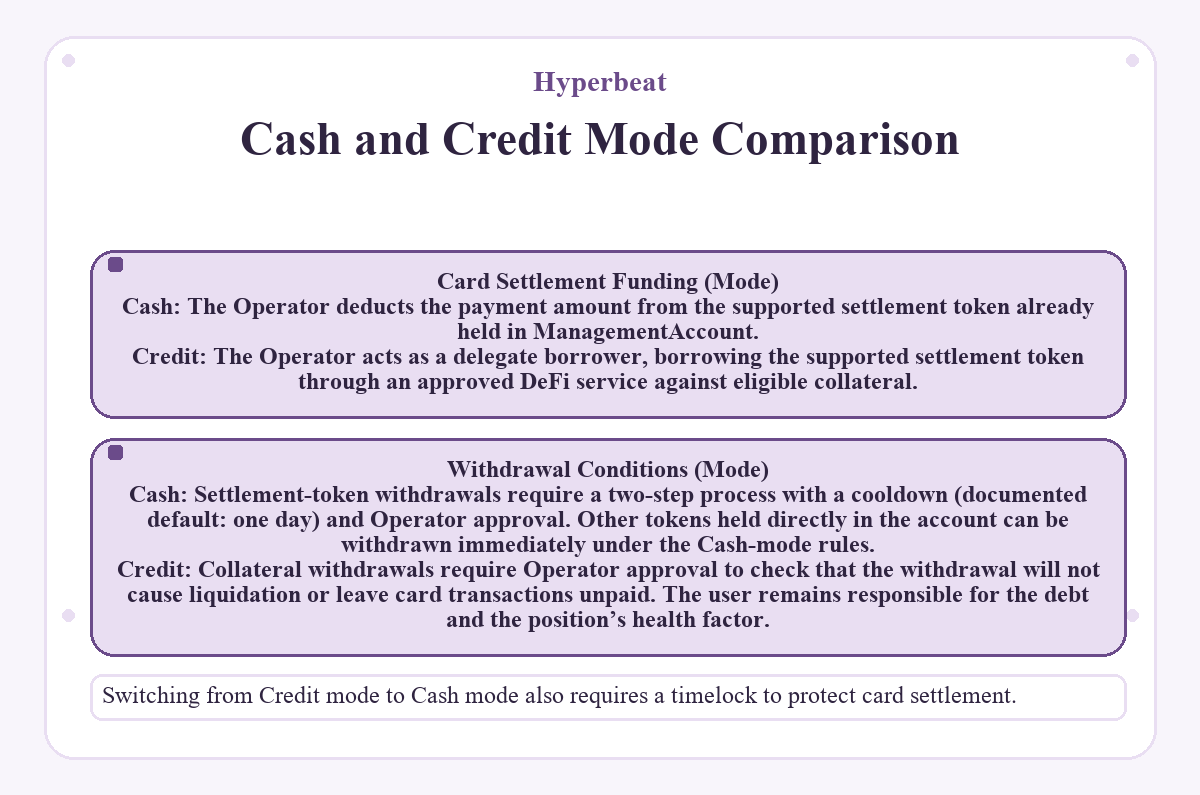
Cash and Credit Mode Comparison
| Mode | Card Settlement Funding | Withdrawal Conditions |
|---|---|---|
| Cash | The Operator deducts the payment amount from the supported settlement token already held in ManagementAccount. | Settlement-token withdrawals require a two-step process with a cooldown (documented default: one day) and Operator approval. Other tokens held directly in the account can be withdrawn immediately under the Cash-mode rules. |
| Credit | The Operator acts as a delegate borrower, borrowing the supported settlement token through an approved DeFi service against eligible collateral. | Collateral withdrawals require Operator approval to check that the withdrawal will not cause liquidation or leave card transactions unpaid. The user remains responsible for the debt and the position’s health factor. |
Switching from Credit mode to Cash mode also requires a timelock to protect card settlement.
Borrowing Costs and Collateral Exposure
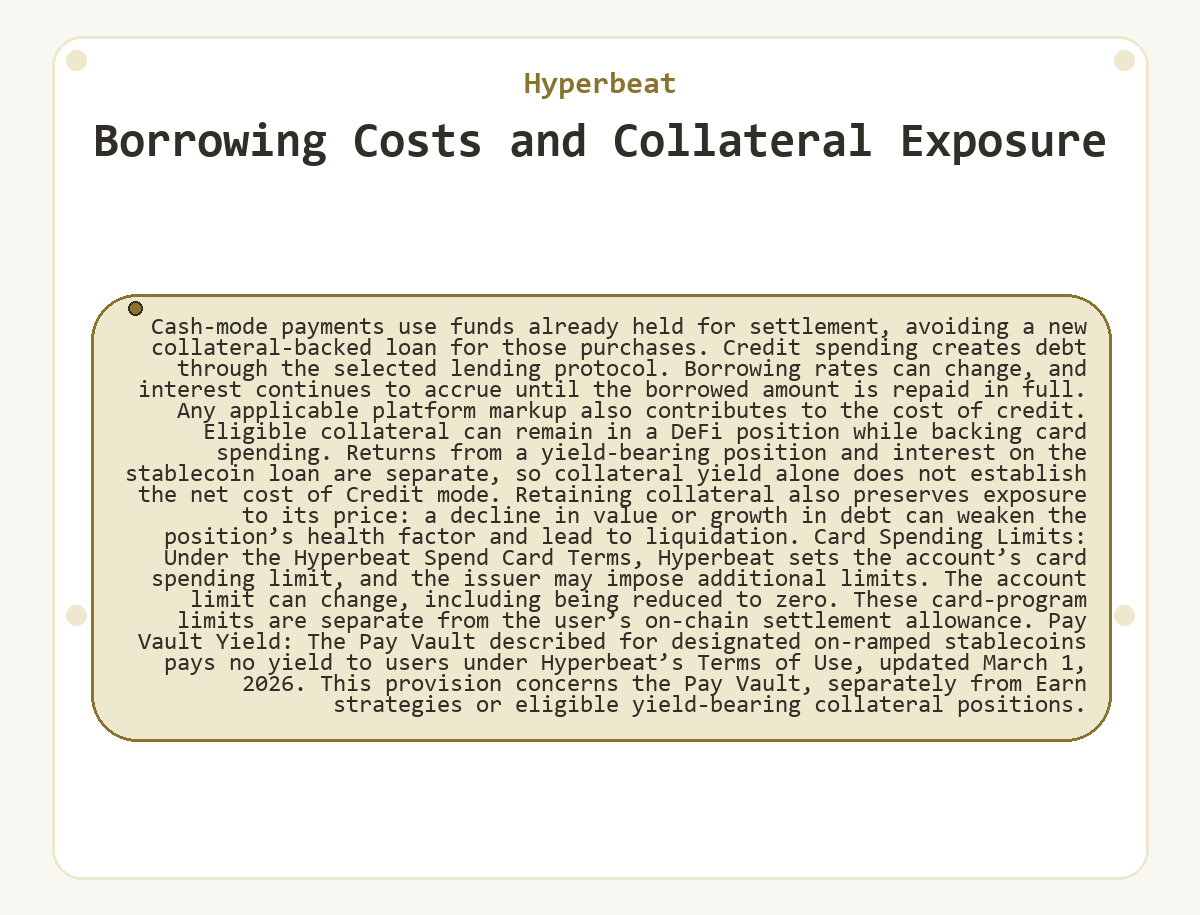
Cash-mode payments use funds already held for settlement, avoiding a new collateral-backed loan for those purchases. Credit spending creates debt through the selected lending protocol. Borrowing rates can change, and interest continues to accrue until the borrowed amount is repaid in full. Any applicable platform markup also contributes to the cost of credit.
Eligible collateral can remain in a DeFi position while backing card spending. Returns from a yield-bearing position and interest on the stablecoin loan are separate, so collateral yield alone does not establish the net cost of Credit mode. Retaining collateral also preserves exposure to its price: a decline in value or growth in debt can weaken the position’s health factor and lead to liquidation.
- Card Spending Limits
- Under the Hyperbeat Spend Card Terms, Hyperbeat sets the account’s card spending limit, and the issuer may impose additional limits. The account limit can change, including being reduced to zero. These card-program limits are separate from the user’s on-chain settlement allowance.
- Pay Vault Yield
- The Pay Vault described for designated on-ramped stablecoins pays no yield to users under Hyperbeat’s Terms of Use, updated March 1, 2026. This provision concerns the Pay Vault, separately from Earn strategies or eligible yield-bearing collateral positions.
Card Program Eligibility and Charges
- U.S. Pay Access
- Hyperbeat’s Terms of Use, updated March 1, 2026, make Pay access for U.S. residents or citizens conditional on the specific requirements of the U.S. cardholder agreement.
- Non-U.S. Card Program
- The Hyperbeat Spend Card Terms describe a card intended for people outside the United States and require applicants to attest that they are not U.S. citizens. That agreement’s listed transaction charges include a non-USD foreign exchange fee of up to 3% and a cross-border fee of up to 3%.
Cash-mode funding remains subject to applicable card and conversion charges. Credit mode adds the lending position’s borrowing costs to those charges.
Token Withdrawals and Bank Cash-Outs
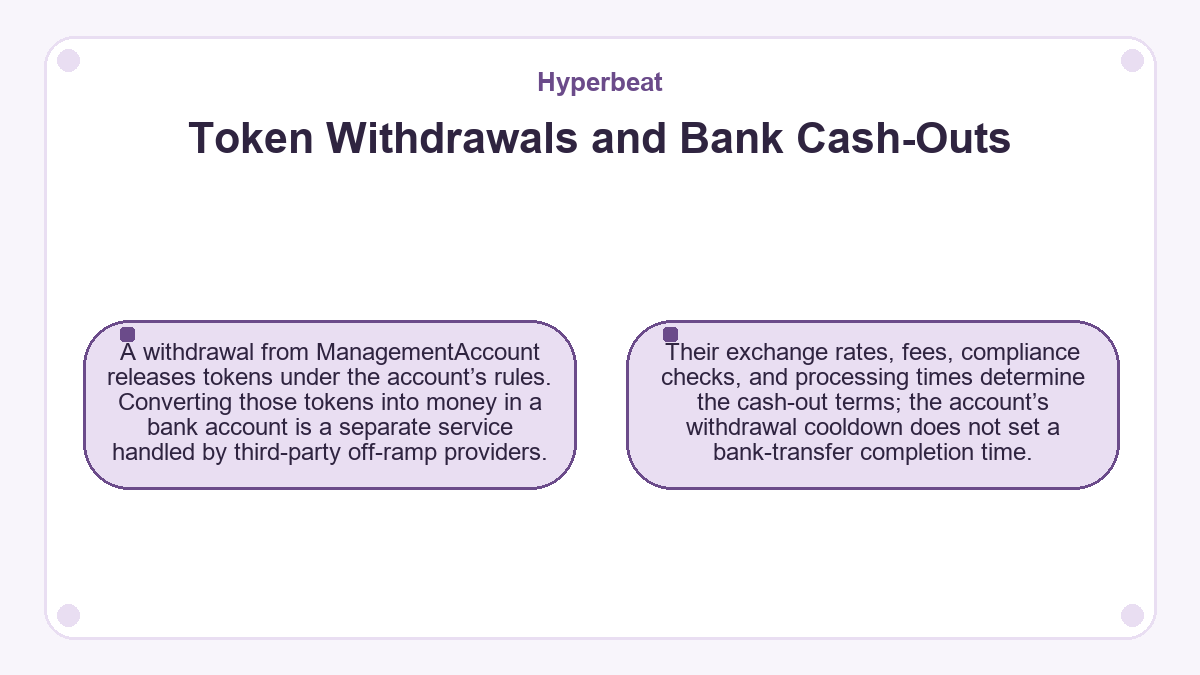
A withdrawal from ManagementAccount releases tokens under the account’s rules. Converting those tokens into money in a bank account is a separate service handled by third-party off-ramp providers. Their exchange rates, fees, compliance checks, and processing times determine the cash-out terms; the account’s withdrawal cooldown does not set a bank-transfer completion time.